
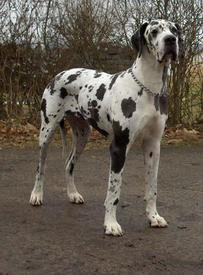
The National Dog of Germany since 1876 - the Great Dane's country of origin - the breed boasts an ancient heritage that dates back as early as 1121 BC. Attributed various nicknames, including the 'Apollo of all dogs' and the 'Gentle Giant,' the popularly know Great Dane is believed to have derived from the Wolfhound, Mastiff and Greyhound respectively. Dogs aligning with our modern-day perception of the Great Dane feature on Greek money dating back to 36 BC, in early Chinese literature and on Egyptian monumental engravings from 3,000 BC. It is widely thought that large, Mastiff-like dogs were first introduced to Germany during the Asiatic invasion of 407 AD, where they were admired for their fierce ability to hunt wild boar and bear and were subsequently cross-bred. The Great Dane was officially recognised in England in 1877.
Perhaps one of the most distinctive breeds for its size alone, the Great Dane boasts mammoth proportions, with long, muscular legs and a powerful body. Characteristic features include a long, rectangular head, dark eyes, a deep muzzle, high-set ears that might be cropped or natural, and a thick coat in colour variations of brindle, black, blue, merle and fawn. Falling within the 'working breed' branch of canines, the Great Dane shares its classification with the Boxer and St. Bernard, originally bred for the purposes of guarding and search and rescue.
Despite its imposing size, the Great Dane is commonly misunderstood, being amongst the most affectionate of breeds, although maintaining a natural vigilance to change and threat and acting fearlessly to protect its family if danger is perceived. Versatile and hardy, the Great Dane makes a great guard dog with keen senses and the inherent ability to discern intruders from those permitted on the property. A loyal and obedient house dog, compatible with children and other house pets when introduced gradually and observed at all times. Weighing an average of 46 kg, although with large discrepancies across gender, and with a life expectancy of 10-12 years of age.
Although not a typically long-lived breed, the Great Dane is generally healthy and resilient. Documented cases of hip dysplasia, bloat and tail injury are common with this breed, as well as more serious incidences of gastric tortion, causing the highest number of Great Dane fatalities, bone weakness due to rapid growth, cardiac disease and mast-cell tumours.

![[REDACTED] [REDACTED]'s Great Dane - Poppy](http://static2.viovet.co.uk/opt/s=kr/petphotos/30866_fd01a2312536a562aee5cca3e532532c.jpg)

![[REDACTED] [REDACTED]'s Great Dane - Milo](http://static1.viovet.co.uk/opt/s=kr/petphotos/32222_96d177234e84a6a49f9980fbd6dd7960.jpg)







From Fife, United Kingdom
Dave is our first Great Dane and just a big very loveable rouge Quite simply put these dogs are a breed apart!
Everyone wants to speak to him - he is better known than us now!
Extremely affectionate breed who will melt everyone's heart and great with children too.
A great asset to any home, I don't think we will ever be without one now.
Iv never had 1 before.
But had many puppies who iv trained.
But i can not train grace.
She pulls on a lead
Will not come back when called
Help
From Hertfordshire, United Kingdom
Best dogs I have ever owned and will always have one !
From Devon, United Kingdom
We have been blessed with Danes for over 25yrs in all we've had black,harley ( they are mad as hatters) 2 fawns, a blue and currently a Mantle. Usually we have 2 but I am at the age that my wife tells me I'm too old to have more than 1. I wouldn't have any other breed although I love all dogs.