
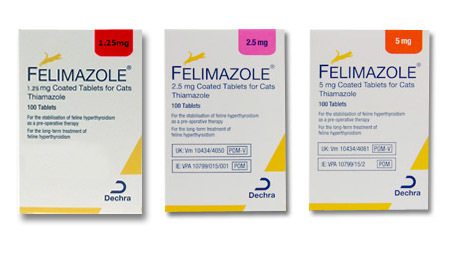
Felimazole is a medication for cats which is used to treat hyperthyroidism. This is a condition which affects mainly older animals and relates to the over-activity of the thyroid gland. The medication controls the amount of hormones released by the thyroid gland.
A cat that has an overactive thyroid may suffer a number of other medical problems as well, such as high blood pressure, a fast heart rate, extreme weight loss and eye problems. If the condition is not treated then the cat may suffer problems with the heart or other organs, blindness and a reduced life expectancy.
Felimazole are small tablets which are sugar coated. They are intended to be administered via the mouth, though this is sometimes hard to do with cats so they can also be added to food.
Most cats will not suffer any side effects from Felimazole and will improve a great deal while taking it. A minority of cats have suffered some side effects such as itchiness around the head and neck which can lead to skin damage from excessive scratching. If more serious side effects are suspected then the cat should be examined by a vet. Those handling the drug should always wash their hands after doing so.
A pet prescription is required to obtain this medication. The drug is available from your vet but usually works out cheaper if obtained from the online supplier VioVet. Your vet must provide a written prescription which can be posted, faxed or emailed to us before the drug can be supplied.
- Product Price QTY
-
Felimazole for Cats » 2.5mg » Priced per TabletEstimated dispatch within 24 working hours. TVP: £0.45 Our price: £0.24 Buy
-
Felimazole for Cats » 5mg » Priced per TabletEstimated dispatch within 24 working hours. TVP: £0.66 Our price: £0.34 Buy
Felimazole® 2.5 mg Coated Tablets for Cats
Presentation
Each tablet contains: Active substance:
Thiamazole 2.5 mg
Excipients: Titanium dioxide (E171) 1.12 mg
Erythrosine (E127) 0.01 mg
Also contains:
Tablet core: Lactose monohydrate, povidone, sodium starch glycolate, magnesium stearate.
Coating: Sucrose, povidone, macrogol, purified talc, white beeswax, carnauba wax, shellac, sodium methyl parahydroxybenzoate (E219).
Pink sugar-coated biconvex tablets, 5.5 mm diameter.
Uses
For the stabilisation of hyperthyroidism in cats prior to surgical thyroidectomy.
For the long term treatment of feline hyperthyroidism.
Dosage and administration
For oral administration only.
For the stabilisation of feline hyperthyroidism prior to surgical thyroidectomy and for the long term treatment of feline hyperthyroidism, the recommended starting dose is 5 mg per day.
Wherever possible, the total daily dose should be divided into two and administered morning and evening. Tablets should not be split.
If, for reasons of compliance, once daily dosing with a 5 mg tablet is preferable, then this is acceptable although the 2.5 mg tablet given twice daily may be more efficacious in the short term. The 5 mg tablet is also suitable for cats requiring higher dose rates.
Haematology, biochemistry and serum total T4 should be assessed before initiating treatment and after 3 weeks, 6 weeks, 10 weeks, 20 weeks, and thereafter every 3 months. At each of the recommended monitoring intervals, the dose should be titrated to effect according to the total T4 and to clinical response to treatment. Dose adjustments should be made in increments of 2.5 mg and the aim should be to achieve the lowest possible dose rate.
If more than 10 mg per day is required animals should be monitored particularly carefully.
The dose administered should not exceed 20 mg/day.
For long term treatment of hyperthyroidism the animal should be treated for life.
Contraindications, warnings, etc
Do not use in cats suffering from systemic disease such as primary liver disease or diabetes mellitus.
Do not use in cats showing signs of autoimmune disease.
Do not use in animals with disorders of white blood cells, such as neutropenia and lymphopenia.
Do not use in animals with platelet disorders and coagulopathies (particularly thrombocytopenia).
Do not use in cats with hypersensitivity to thiamazole or the excipient, polyethylene glycol.
Do not use in pregnant or lactating females.
Please refer to Use during pregnancy and lactation.
Special warnings for each target species: As thiamazole can cause haemoconcentration, cats should always have access to drinking water.
Special precautions for use in animals: If more than 10 mg per day is required animals should be monitored particularly carefully.
Use of the product in cats with renal dysfunction should be subject to careful risk/benefit assessment by the clinician. Due to the effect thiamazole can have on reducing the glomerular filtration rate, the effect of therapy on renal function should be monitored closely as deterioration of an underlying condition may occur.
Haematology must be monitored due to risk of leucopenia or haemolytic anaemia.
Any animal that suddenly appears unwell during therapy, particularly if they are febrile, should have a blood sample taken for routine haematology and biochemistry. Neutropenic animals (neutrophil counts <2.5 x 10⁹/l) should be treated with prophylactic bactericidal antibacterial drugs and supportive therapy.
Please refer to 'Dosage and administration' for monitoring instructions.
Special precautions to be taken by the person administering the veterinary medicinal product to animals: Wash hands after use.
In the case of accidental ingestion, seek medical advice immediately and show the package leaflet or the label to the physician.
Thiamazole may cause vomiting, epigastric distress, headache, fever, arthralgia, pruritus and pancytopaenia. Treatment is symptomatic.
Wash hands with soap and water after handling litter used by treated animals.
Do not eat, drink or smoke while handling the tablet or used litter.
Do not handle this product if you are allergic to anti-thyroid products. If allergic symptoms develop, such as a skin rash, swelling of the face, lips or eyes or difficulty in breathing, you should seek medical attention immediately and show the package leaflet or label to the doctor.
Do not break or crush tablets.
As thiamazole is a suspected human teratogen, women of child-bearing age and pregnant women should wear gloves when handling litter of treated cats.
Pregnant women should wear gloves when handling the product.
Adverse reactions: Adverse reactions have been reported following long term control of hyperthyroidism. In many cases, signs may be mild and transitory and not a reason for withdrawal of treatment. The more serious effects are mainly reversible when medication is stopped.
Adverse reactions are uncommon. The most common clinical side effects that are reported include vomiting, inappetance/anorexia, lethargy, severe pruritus and excoriations of the head and neck, bleeding diathesis and icterus associated with hepatopathy, and haematological abnormalities (eosinophilia, lymphocytosis, neutropenia, lymphopenia, slight leucopenia, agranulocytosis, thrombocytopenia or haemolytic anaemia). These side effects resolve within 7-45 days after cessation of thiamazole therapy.
Possible immunological side effects include anaemia, with rare side effects including thrombocytopenia and serum anti-nuclear antibodies, and, very rarely, lymphadenopathy can occur. Treatment should be stopped immediately and alternative therapy considered following a suitable period for recovery.
Following long term treatment with thiamazole in rodents, an increased risk of neoplasia in the thyroid gland has been shown to occur, but no evidence is available in cats.
Use during pregnancy and lactation: Laboratory studies in rats and mice have shown evidence of teratogenic and embryotoxic effects of thiamazole. The safety of the product was not assessed in pregnant or lactating cats. Do not use in pregnant or lactating females.
Interactions: Concurrent treatment with phenobarbital may reduce the clinical efficacy of thiamazole.
Thiamazole is known to reduce the hepatic oxidation of benzimidazole wormers and may lead to increases in their plasma concentrations when given concurrently.
Thiamazole is immunomodulatory, therefore this should be taken into account when considering vaccination programmes.
Overdose: In tolerance studies in young healthy cats, the following dose-related clinical signs occurred at doses of up to 30 mg/animal/day: anorexia, vomiting, lethargy, pruritus and haematological and biochemical abnormalities such as neutropenia, lymphopenia, reduced serum potassium and phosphorus levels, increased magnesium and creatinine levels and the occurrence of anti-nuclear antibodies. At a dose of 30 mg/day some cats showed signs of haemolytic anaemia and severe clinical deterioration. Some of these signs may also occur in hyperthyroid cats treated at doses of up to 20 mg per day.
Excessive doses in hyperthyroid cats may result in signs of hypothyroidism. This is however unlikely, as hypothyroidism is usually corrected by negative feedback mechanisms. Please refer to Adverse reactions.
If overdosage occurs, stop treatment and give symptomatic and supportive care.
Incompatibilities: None known.
Pharmaceutical precautions
Do not store above 25°C. Keep the container tightly closed in order to protect from moisture. Keep the container in the outer carton. Do not use after the expiry date which is stated on the label and carton after EXP.
Shelf life of the veterinary medicinal product as packaged for sale: 3 years.
Disposal: Any unused veterinary medicinal product or waste materials derived from such veterinary medicinal products should be disposed of in accordance with local requirements.
Legal category
POM-V
Packaging quantities
White polypropylene tub with white low density polyethylene tamper evident lid containing 100 tablets.
Further information
For animal treatment only. To be supplied only on veterinary prescription. Keep out of the reach and sight of children.
Manufacturer for the batch release: Dales Pharmaceuticals, Snaygill Industrial Estate, Keighley Road, Skipton, North Yorkshire, BD23 2RW.
Date of last review: April 2012
Marketing authorisation holder (if different from distributor)
Dechra Limited, Dechra House, Jamage Industrial Estate, Talke Pits, Stoke-on-Trent, Staffordshire, ST7 1XW.
Marketing authorisation number
Vm 10434/4050.
GTIN (Global Trade Item No)
Felimazole 2.5 mg Coated Tablets for Cats
05055031410477
Felimazole® 5 mg Coated Tablets for Cats
Presentation
Each tablet contains: Active substance:
Thiamazole 5 mg
Excipients: Titanium dioxide (E171) 0.495 mg
Beta carotene (E160a) 0.16 mg
Also contains:
Tablet core: Lactose monohydrate, povidone, sodium starch glycollate, magnesium stearate.
Coating: Sodium methyl hydroxybenzoate (E219), sucrose, povidone, macrogol, purified talc, white beeswax, carnuba wax, shellac.
Orange sugar-coated biconvex tablets, 5.5 mm diameter.
Uses
For the stabilisation of hyperthyroidism in cats prior to surgical thyroidectomy.
For the long term treatment of feline hyperthyroidism.
Dosage and administration
For oral administration only.
For the stabilisation of feline hyperthyroidism prior to surgical thyroidectomy and for the long term treatment of feline hyperthyroidism, the recommended starting dose is 5 mg per day.
Wherever possible, the total daily dose should be divided into two and administered morning and evening. Tablets should not be split.
If, for reasons of compliance, once daily dosing with a 5 mg tablet is preferable, then this is acceptable although the 2.5 mg tablet given twice daily may be more efficacious in the short term. The 5 mg tablet is also suitable for cats requiring higher dose rates.
Haematology, biochemistry and serum total T4 should be assessed before initiating treatment and after 3 weeks, 6 weeks, 10 weeks, 20 weeks, and thereafter every 3 months. At each of the recommended monitoring intervals, the dose should be titrated to effect according to the total T4 and to clinical response to treatment. Dose adjustments should be made in increments of 2.5 mg and the aim should be to achieve the lowest possible dose rate.
If more than 10 mg per day is required animals should be monitored particularly carefully.
The dose administered should not exceed 20 mg/day.
For long term treatment of hyperthyroidism, the animal should be treated for life.
Contraindications, warnings, etc
Do not use in cats suffering from systemic disease such as primary liver disease or diabetes mellitus.
Do not use in cats showing signs of autoimmune disease.
Do not use in animals with disorders of white blood cells, such as neutropenia and lymphopenia.
Do not use in animals with platelet disorders and coagulopathies (particularly thrombocytopenia).
Do not use in cats with hypersensitivity to thiamazole or the excipient, polyethylene glycol.
Do not use in pregnant or lactating females.
Please refer to Use during pregnancy and lactation.
Special warnings for each target species: As thiamazole can cause haemoconcentration, cats should always have access to drinking water.
Special precautions for use in animals: If more than 10 mg per day is required animals should be monitored particularly carefully.
Use of the product in cats with renal dysfunction should be subject to careful risk/benefit assessment by the clinician. Due to the effect thiamazole can have on reducing the glomerular filtration rate, the effect of therapy on renal function should be monitored closely as deterioration of an underlying condition may occur.
Haematology must be monitored due to risk of leucopenia or haemolytic anaemia.
Any animal that suddenly appears unwell during therapy, particularly if they are febrile, should have a blood sample taken for routine haematology and biochemistry. Neutropenic animals (neutrophil counts <2.5 x 10⁹/l) should be treated with prophylactic bactericidal antibacterial drugs and supportive therapy.
Please refer to 'Dosage and administration' for monitoring instructions.
Special precautions to be taken by the person administering the veterinary medicinal product to animals: Wash hands after use.
In the case of accidental ingestion, seek medical advice immediately and show the package leaflet or the label to the physician.
Thiamazole may cause vomiting, epigastric distress, headache, fever, arthralgia, pruritus and pancytopenia. Treatment is symptomatic.
Wash hands with soap and water after handling litter used by treated animals.
Do not eat, drink or smoke while handling the tablet or used litter.
Do not handle this product if you are allergic to anti-thyroid products. If allergic symptoms develop, such as a skin rash, swelling of the face, lips or eyes or difficulty in breathing, you should seek medical attention immediately and show the package leaflet or label to the doctor.
Do not break or crush tablets.
As thiamazole is a suspected human teratogen, women of child-bearing age and pregnant women should wear gloves when handling litter of treated cats.
Pregnant women should wear gloves when handling the product.
Adverse reactions: Adverse reactions have been reported following long term control of hyperthyroidism. In many cases, signs may be mild and transitory and not a reason for withdrawal of treatment. The more serious effects are mainly reversible when medication is stopped.
Adverse reactions are uncommon. The most common clinical side effects that are reported include vomiting, inappetance/anorexia, lethargy, severe pruritus and excoriations of the head and neck, bleeding diathesis and icterus associated with hepatopathy, and haematological abnormalities (eosinophilia, lymphocytosis, neutropenia, lymphopenia, slight leucopenia, agranulocytosis, thrombocytopenia or haemolytic anaemia). These side effects resolve within 7-45 days after cessation of thiamazole therapy.
Possible immunological side effects include anaemia, with rare side effects including thrombocytopenia and serum anti-nuclear antibodies, and, very rarely, lymphadenopathy can occur. Treatment should be stopped immediately and alternative therapy considered following a suitable period for recovery.
Following long term treatment with thiamazole in rodents, an increased risk of neoplasia in the thyroid gland has been shown to occur, but no evidence is available in cats.
Use during pregnancy and lactation: Laboratory studies in rats and mice have shown evidence of teratogenic and embryotoxic effects of thiamazole. The safety of the product was not assessed in pregnant or lactating cats. Do not use in pregnant or lactating females.
Interactions: Concurrent treatment with phenobarbital may reduce the clinical efficacy of thiamazole.
Thiamazole is known to reduce the hepatic oxidation of benzimidazole wormers and may lead to increases in their plasma concentrations when given concurrently.
Thiamazole is immunomodulatory, therefore this should be taken into account when considering vaccination programmes.
Overdose: In tolerance studies in young healthy cats, the following dose-related clinical signs occurred at doses of up to 30 mg/animal/day: anorexia, vomiting, lethargy, pruritus and haematological and biochemical abnormalities such as neutropenia, lymphopenia, reduced serum potassium and phosphorus levels, increased magnesium and creatinine levels and the occurrence of anti-nuclear antibodies. At a dose of 30 mg/day some cats showed signs of haemolytic anaemia and severe clinical deterioration. Some of these signs may also occur in hyperthyroid cats treated at doses of up to 20 mg per day.
Excessive doses in hyperthyroid cats may result in signs of hypothyroidism. This is however unlikely, as hypothyroidism is usually corrected by negative feedback mechanisms. Please refer to Adverse reactions.
If overdosage occurs, stop treatment and give symptomatic and supportive care.
Incompatibilities: None known.
Pharmaceutical precautions
Do not store above 25°C. Keep the container tightly closed in order to protect from moisture. Keep the container in the outer carton. Do not use after the expiry date which is stated on the label and carton after EXP.
Shelf life of the veterinary medicinal product as packaged for sale: 5 years.
Disposal: Any unused veterinary medicinal product or waste materials derived from such veterinary medicinal products should be disposed of in accordance with local requirements.
Legal category
POM-V
Packaging quantities
White polypropylene tub with white low density polyethylene tamper evident lid containing 100 tablets.
Further information
For animal treatment only. To be supplied only on veterinary prescription. Keep out of the reach and sight of children.
Manufacturer for the batch release: Dales Pharmaceuticals, Snaygill Industrial Estate, Keighley Road, Skipton, North Yorkshire, BD23 2RW.
Date of last review: July 2012
Marketing authorisation holder (if different from distributor)
Dechra Limited, Dechra House, Jamage Industrial Estate, Talke Pits, Stoke-on-Trent, Staffordshire, ST7 1XW.
Marketing authorisation number
Vm 10434/4061.
GTIN (Global Trade Item No)
Felimazole 5 mg Coated Tablets for Cats
05055031410651
Need help or advice? Contact us:
- Freephone: 0800 084 2608
- Mon - Fri: 8:30am - 7:00pm
- Sat: 10:00am - 3:00pm
- Email: support@viovet.co.uk
All prices include VAT where applicable.
No Reviews For Felimazole for Cats
Have you tried Felimazole for Cats? Be the first to write a review!