
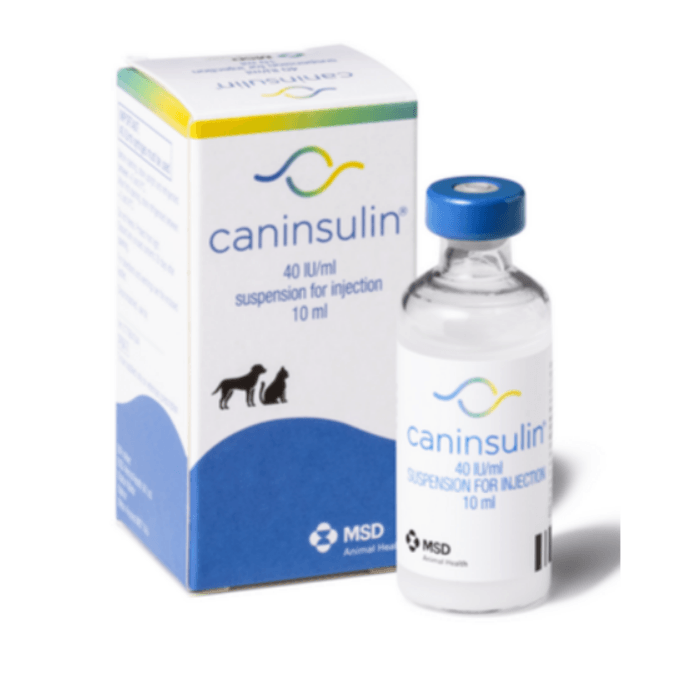
Images are for illustration purposes only. Packaging may change from time to time and images on our website may or may not be updated.
Selection of 8 products from
£10.49 to £103.00


Caninsulin is derived from porcine insulin, which is chemically identical to the insulin found in dogs. It has an intermediate period of activity, meaning that it can suit once- or twice-daily treatment regimens for diabetes mellitus. It is important that your vet performs the appropriate blood tests first and tailors a treatment protocol which suits your individual dog or cat.
For compatible syringes and needles click here.
2024 product update - Caninsulin is now only manufactured and supplied in a new formulation (marked by a blue topped bottle) which only differs in the addition of a preservative. This change has no effect on the amount of insulin that each unit of the medication provides but it does provide additional benefits for storage. Once breached, bottles and cartridges can now be stored for up to 42 days and at room temperature (up to 25°C).
It is important to note that the concentration of Caninsulin is different from all other types of insulin available on the market, to make it easier to give the smaller doses often needed compared with human treatments. This means that only Caninsulin syringes are suitable for use with Caninsulin (calibrated at 40 international units per ml), and human syringes (calibrated at 100 international units per ml) should not be used because they will not give the stated dose. Caninsulin can be given by conventional syringe and needle or using the Caninsulin Vetpen which takes 2.7ml cartridges and single use disposable needles. For more information on treatment, see below:
The basic rules for successful treatment of diabetes mellitus in dogs and cats revolve around correct, consistent feeding and a regular, consistent daily routine. Suitable diets are lower in carbohydrate and higher in fat and protein than many commercial diets. An animal on a once-daily injection of insulin should receive about one third of the daily food ration at the same time as the injection, then the main meal of the day should be given to coincide with the peak activity of that injection, which is usually about eight hours later. Animals on twice daily injections can be fed more evenly through the day which tends to suit cats much better. Dogs and cats show a very poor response to the tablets used for some types of diabetes in people (the oral hypoglycaemics) and so insulin injections every day are the only real option.
If the amount of insulin given is too low, then your dog or cat will have an excessive thirst and may lose weight. There will also be a significant risk of other problems such blindness (due to diabetic cataracts in dogs, or diabetic retinopathy in cats). If too much insulin is given, your pet will feel unwell and might well suffer a hypoglycaemic episode (a "hypo") which can cause weakness, staggering, and trembling, occasionally leading to fitting, coma, and even death. If this is happening, it can quickly be rectified by giving a little glucose or honey by mouth. DO NOT give extra insulin.
It is important to have regular blood tests to monitor how well treatment is working.
With care such as Caninsulin it is usually possible to treat dogs or cats very successfully for years. It is also interesting to note that a fair proportion of cats will only suffer from diabetes temporarily, and spontaneous recovery does sometimes happen. Recovered cats no longer require insulin injections as long as they are maintained on a suitable diet. Caninsulin is not licensed for use in cats, but there are currently no licensed treatments for diabetes in cats — however Caninsulin has been found by vets to work very well.
How to use Caninsulin VetPen:
VetPen Starket Kit includes:
Browse our range of prescription medications.
All prices include VAT where applicable.
| Overall | |
| Effectiveness | |
| Ease Of Use | |
| Value For Money | |
| Absence Of Side Effects |
Only verified purchasers of this product can leave a review.
Prescribed by my vet
Customer recommends this product
We were out for the day but the Caninsulin was well insulated in freezer pack so very pleased when we unwrapped it and stored in our fridge
Customer recommends this product
I have no thoughts - I'm eating my dinner
Customer recommends this product
The same product at half the price if I had bought locally.
Customer recommends this product
After being ripped of by vets who charge nearly 4 times as much as Viovet, I got a prescription and saved over £200 with Viovet
Customer recommends this product
Below are some recent questions we've received regarding Caninsulin Insulin for Cats & Dogs, including answers from our team.
Pauline how do you deliver In
How do you deliver your insulin for dogs
Caninsulin is a temperature controlled medication, it must be refridgerated. This means we deliver it within temperature controlled packaging. This has been tested to ensure the correct storage conditions are maintained for at least 24 hours from dispatch, and in some cases up to 48 hours. We only ship this product via next day delivery to ensure it is delivered within 24 hours safely.
Megan
can a take my empty bottle and get it topped up at waitrose ,as i read u can.and if u order on line with a prescription ,are u limited to amount u can order at a time.
There is no possible way of getting the bottles topped up at Waitrose or anywhere else. This is a pharmaceutical product manufactured and packed with absolute sterility and under massive quality controls. Products like this can only be bought from vets, or a small number of other, approved retailers. When a vet provides a prescription, it is always us pt the vet to state how much is authorised on that prescription. It is never an unlimited amount.
Paul
I was given to understand by our vet that Caninsulin should be gently shaken before every administration.
Is this correct or am I mistaken?
Paul
Caninsulin contains a suspension and so can settle out if left still for a long time. On that basis it should be agitated in some way to produce an even dispersion of the contents before withdrawing a dose. The problem with this is that it is well known that repeated, vigorous shaking can denature any type of insulin and render it inactive. The facts are that it only takes a bit of movement to re-suspend the contents and it takes a huge amount of shaking to cause any significant trouble to the insulin. Therefore as long as you are sensible about it, the whole process works very well. It is advised to gently roll the bottle in your hands or on a surface before withdrawing a dose. This can be done twice a day for a month and will be effective, but not damage the insulin. There is a lot more leeway than some people seem to think. (It is recommended that if there is any insulin left after a month, this is discarded and a new bottle started. This is due more to possible contamination than anything else.)
Rachael
Hi, my dog needs 3 units am and pm. If we buy a 10 ml bottle can you tell me how long this will last.
thanks
Caninsulin contains 40 units per ml, therefore in a 10ml bottle you get 10 x 40 = 400 units. If you use 6 units per day, this should last 66 days. However it is not recommended to keep using the bottle for more than 28 days after you have removed the first dose. (Though it lasts for 2 years in the fridge if it is not opened.) Whenever a multi-use injection bottle has first been used, there is an official recommendation to discard any unused product after 28 days, due to degradation which might possibly occur through contaminants accidentally being introduced by the needle when some is withdrawn. I am sure that many people continue to use it longer than 28 days but we cannot recommend this. If you buy a 2.5ml bottle, that should last for 16 days. (2.5 x 40 = 100, 100 / 6 = 16.7)
marie cane
how long does caninsulin keep its efectiveness after the vial has been opened.
The stability tests on Caninsulin have demonstrated that even if kept at room temperature (below 25 C) and not stored in a fridge, it will remain affective for at least 28 days from opening. How much longer than that it will last for has not been published. This is partly because all multi-dose injections are recommended to be used only for a maximum of 28 days anyway. The chances of contamination through repeated needle entry into the bottle are a concern the longer it is used for. Therefore the arbitrary 28 day maximum has been set as a safe guideline. I expect that it would last much longer than this, especially if kept in the fridge, but the advice is to discard any left after 28 days anyway for safety reasons.
Stephanie Reid
Is it safe for insulin to be dispatched by post?
As a precaution, we post out insulin in a cold pack, which should keep the product cool for a period of 3 days. However, the fact is that Caninsulin (along with other forms of insulin) is not as temperature sensitive as many people believe. If you read the data sheet from the manufacturer which accompanies the product, you will see that they are confident that it can be stored at room temperature for 28 days. Long-term storage is advised to be at fridge temperature, but they are happy once the product is in use, for it not to be fridged at all. (This has some benefits for patient comfort - the insulin is not cold when injected. Some human hospitals apparently do not fridge their supplies once they are in use. It is important to discard any remaining product once the vial has been broached for 28 days. This is mostly due to potential contamination concerns in fact.)
Other theoretical concerns for insulin being sent by post are prolonged contact with the rubber stopper in the top of the vial, and repeated shaking. Both of these things can cause some degradation of the insulin and reduction of efficacy. However these concerns have been evaluated by various manufacturers and large scale users of insulin, and the degree of degradation in normal circumstances is insignificant. We are confident that Caninsulin can safely be sent by post.
Question answered by Dr. John Cousins BVSc MRCVS
Barbara Sheffield
Do you know if there is such a thing on the market as a Canine version, of the Human Insulin, Epipen?
My mums dog is now having to have 2 injections a day and I wondered if there was an easier way of measuring the dose of insulin, as in the human diabetic's insulin pen?
Yes there is the Caninsulin Vetpen available and this is on our website now. I have not used them
personally, but I understand that they are simple enough. The insulin is
supplied in Caninsulin Cartridges which makes it a bit more expensive, and the pen itself costs money,
but they are designed for easy use and are becoming more popular.
Question answered by Dr. John Cousins BVSc MRCVS
Hazel
As you know you are not supposed to shake insulin as it destroys its active ingredients/potency.
Surely sending it in the post will definitely shake it, how is this problem overcome?.
Thanks
There are in fact several reasons why theoretically sending insulin by post is not ideal. In practice, none of them seem to be significant and thousands of bottles are posted regularly and found to be perfectly effective. The insulin molecule can indeed be denatured by repeated shaking, which would render the product inactive. This is important to point out because some people might be tempted to shake the bottle vigorously every time they use it, which can be twice a day for a month. (In the days before the 28 day maximum use limit was introduced, some bottles were in use for several months.) In practice the amount of inadvertent shaking the insulin receives is not found to have a noticeable affect on the quality of the product. Each insulin bottle is moved around several times between manufacture and end use. It will at least be moved by van from manufacturer to wholesaler, then from wholesaler to retailer. At all times care is taken to do this with the nature of the product in mind. Fortunately insulin molecule is not as fragile as some people fear, and the system works very well.
Insulin also denatures when stored in contact with rubber, or if stored above fridge temperature. When sent by post, it will inevitably be in contact for at least some of the time with the rubber stopper used in the bottle. (When stored in the fridge, it should always be held upright.) Insulin is always posted in an insulated cold pack. However it is difficult to know how effective these packs are, especially when the ambient temperature is very high. Again the concerns seem to be more theoretical than practical. Caninsulin has a 2 year use-by date on it from manufacture. Over this length of time, storage at warm temperatures, or in contact with the rubber stopper, might well cause significant deterioration. Over the short period it is in the post, these concerns have been found not to cause any trouble. (In fact regarding the temperature issue, the data sheet with the product points out that it can be stored for a month at room temperature, so that once the bottle has been brought into use, it does not have to be fridged at all. This can be helpful for pets which are sensitive to cold injections, so it is injected at room temperature. Any product left after 28 days should be discarded, due to possible contamination and degradation, so the temperature issue does not come into pay.)
The main thing to remember is that insulin is not as robust as many other medications and should be treated with care. However it is not terribly fragile either and with a little care, the theoretical concerns do not amount to anything in practice. Experience has shown that in using insulin sent by post works perfectly well. The day to day management of a diabetic patient is probably affect more by changes in eating, exercise, "stress" etc, rather than posted insulin.


